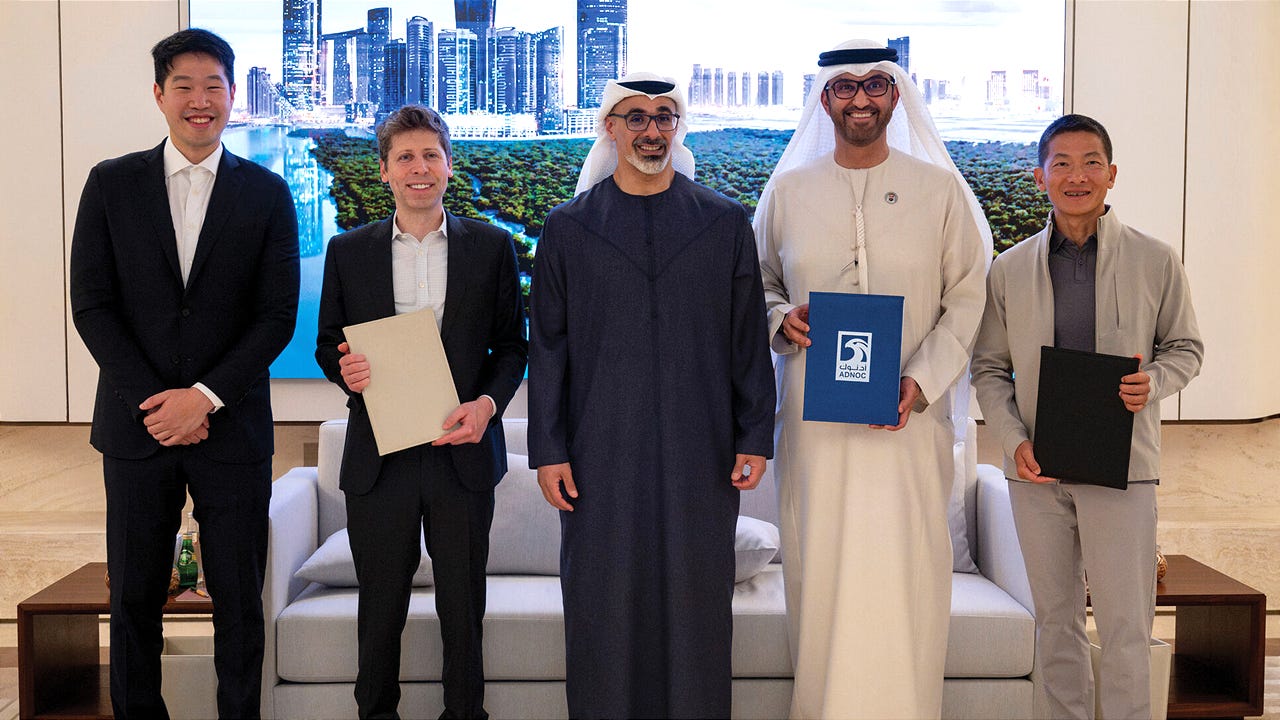
On November 2, 2026, OpenAI CEO Sam Altman stood in Abu Dhabi and signed a series of agreements that could reshape the company's future. The deals, announced during the ADIPEC energy conference, span four key sectors: energy, government, investment, and AI deployment. They were signed in the presence of Sheikh Khaled bin Mohamed bin Zayed Al Nahyan, the Crown Prince of Abu Dhabi, and they mark a major expansion of OpenAI's presence in the Middle East.
The OpenAI UAE deal is not just a business partnership. It is a strategic alliance. It gives OpenAI access to some of the world's cheapest and most abundant energy, a government willing to redesign its entire bureaucracy around AI, and a sovereign wealth fund with billions of dollars to invest. In return, the UAE gets access to the most advanced AI models on the planet. For OpenAI, the timing is critical. The company is in the middle of a difficult fundraising round, and the Middle East is quickly becoming its most important source of capital.
Inside the Four Landmark Deals
The agreements signed in Abu Dhabi are comprehensive. They touch nearly every part of the UAE's economy and government. According to official statements and reports from the scene, the deals break down into four main pillars.
The first and most prominent deal is in the energy sector. ADNOC, the Abu Dhabi National Oil Company, has become the first energy company in the world to deploy OpenAI's frontier technology across its operations. The multiyear partnership involves OpenAI, ADNOC, and the AI firm G42, working through its subsidiary Inception42. The goal is to integrate AI into ADNOC's operational, investment, and commercial decision-making. The technology will run on OpenAI's GPT models using in-country inference infrastructure in the UAE. This means the data stays in the country, which is a major concern for any government or state-owned enterprise.
The second deal is with the Abu Dhabi government. Together, they launched what they describe as the world's first AI-native Machine-Readable Government initiative. This is a bold experiment. The plan is to convert government policies and regulations into machine-readable formats. AI systems will then assist officials with routine regulatory compliance assessments, including applications for permits and certificates. The first pilot is already operational with the Abu Dhabi Agriculture and Food Safety Authority, focusing on food imports. Every assessment is traceable to the relevant regulation, and human officials retain final oversight.
The third deal is in investment. Mubadala, one of the world's largest sovereign wealth funds, along with Inception42 and OpenAI, will apply advanced AI capabilities to investment analysis. The goal is to identify opportunities and assess risks faster and more accurately. This is a major vote of confidence in OpenAI's technology from one of the most sophisticated investors in the world.
The fourth deal focuses on AI deployment and workforce training. Inception42 and OpenAI signed a five-year agreement to expand the adoption of AI tools across the UAE. The partnership also focuses on developing human capabilities, giving employees access to AI tools so they can experiment, build applications, and acquire new skills. As Rod Solaimani, OpenAI's Policy and Partnerships Lead for MENA and Central Asia, explained, the goal is to help knowledge workers build engineering capabilities and help engineers specialize in AI.
The $20 Billion Funding Crunch
The UAE deals did not happen in a vacuum. They are directly tied to OpenAI's urgent need for capital. Just days before the agreements were signed, reports emerged that OpenAI had slashed the target for its latest funding round. The company was originally seeking $30 billion, but it has now lowered that target to $20 billion. Even more concerning, the company had only secured about $11 billion in commitments, less than half of its original goal.
This is a stark reversal for a company that has been the darling of Silicon Valley. The reasons for the funding crunch are complex. The recent US stock market crash and AI sell-off has made investors far more cautious. The massive spending plans of the hyperscalers, combined with their negative free cash flow, have spooked the market. And competition is intensifying. Anthropic, OpenAI's arch-rival, is preparing to go public, and its S-1 filing showed revenue soaring and cash flow turning positive.
The financial pressure is immense. OpenAI is spending billions of dollars on compute power, talent, and infrastructure. It needs a steady stream of cash to keep the lights on. The Middle East, with its sovereign wealth funds and desire to diversify away from oil, is one of the few places where that kind of capital is still available. Here is a breakdown of the key numbers behind the funding push and the UAE deals.
| Metric | Data | What It Means |
|---|---|---|
| Original Funding Target | $30 Billion | OpenAI's initial goal for its latest round |
| Revised Funding Target | $20 Billion | Lowered after market conditions worsened |
| Capital Raised So Far | ~$11 Billion | Less than half of the original target |
| Reported Valuation | $1.25 Trillion | Down from an earlier target of $1.4 trillion |
| Key UAE Partners | ADNOC, G42, Mubadala, Abu Dhabi Government | Energy, AI, investment, and government sectors |
| ADNOC Deployment | First energy company to use OpenAI Frontier | AI integrated into operational and commercial decisions |
The table shows a company that is under pressure but still has enormous ambition. The UAE deals give OpenAI a major foothold in a region that is determined to become a global AI hub. They also give the company a credible story to tell investors. It is not just a consumer app company. It is a strategic partner to governments and energy giants. For more on the broader capital crunch in the AI industry, you can read our coverage of the AI boom's capital supply crunch.
Why the UAE Is the Perfect Partner
The UAE has been aggressively positioning itself as a global leader in artificial intelligence. The country has a national strategy for AI, a minister dedicated to the portfolio, and a sovereign wealth fund that is willing to make bold bets. But the partnership with OpenAI is about more than just money.
Energy is the key. AI requires enormous amounts of electricity. As Rod Solaimani noted, expanding access to AI requires substantial computing capacity, which in turn depends on abundant and reliable energy supplies. The UAE has some of the cheapest energy in the world. By partnering with ADNOC, OpenAI is not just getting access to a customer. It is getting access to the energy needed to power its data centers.
The government partnership is equally important. The AI-native Machine-Readable Government initiative is a radical experiment. If it works, it could serve as a model for governments around the world. It could also give OpenAI a powerful reference case. When other countries see what the UAE has built, they may want the same thing. This is a classic enterprise sales strategy, but applied at the level of an entire nation.
The investment partnership with Mubadala is the financial engine. Mubadala has deep pockets and a long history of investing in technology. It is also a signal to other investors. If Mubadala is willing to bet on OpenAI, it makes the company look safer and more attractive. The five-year deployment agreement is the final piece of the puzzle. It ensures that the technology is not just signed but actually implemented.
The Risks and the Challenges
The OpenAI UAE deal is not without risks. The Middle East is a complex geopolitical region. OpenAI is now tied to a government that has its own agenda and its own relationships with other countries. This could create complications, especially as the US-Israel-Iran conflict continues to simmer. As Al-Monitor reported, the deals were signed amid pressure from that war.
There is also the issue of data sovereignty. The UAE has been very clear that it wants AI infrastructure to be in-country. This is a reasonable demand, but it adds complexity and cost. OpenAI has agreed to run inference on GPUs within UAE data centers, but this may not be enough to satisfy all concerns. As the technology becomes more deeply embedded in government operations, the stakes will rise.
Finally, there is the question of execution. Signing deals is easy. Building a machine-readable government is hard. It requires deep collaboration between engineers, policymakers, and regulators. It requires a level of trust that is difficult to build in a short period of time. The pilot with the Abu Dhabi Agriculture and Food Safety Authority is a good start. But scaling it to the entire government will be a massive undertaking.
What This Means for OpenAI and the AI Industry
The OpenAI UAE deal is a bold move. It gives the company a lifeline at a time when Wall Street is tightening its purse strings. It also gives the UAE a major advantage in the race to become a global AI hub. The partnership could become a model for how AI companies and governments work together in the future.
For the AI industry, the message is clear. The era of easy money from Silicon Valley venture capitalists is ending. The next wave of funding will come from sovereign wealth funds, energy companies, and governments. These investors have different priorities. They want strategic control, long-term partnerships, and a say in how the technology is deployed. The companies that can adapt to these new expectations will thrive. Those that cannot will struggle.
For OpenAI, the UAE deal is a chance to prove that it can be more than just a consumer app. It can be the foundational infrastructure for governments and industries. If it succeeds, it will silence the critics and justify its massive valuation. If it fails, the company will have a much harder time raising money in the future. The stakes could not be higher. As we noted in our article on the hidden costs of personal AI agents, compute power is the next big challenge. The UAE deal is OpenAI's attempt to secure both the capital and the energy needed to solve it.