On the morning of November 5, 2026, a company called Agility Robotics began trading on the Nasdaq stock exchange. Its ticker symbol is AGLT. This might sound like just another tech company going public. But it is not. Agility is the first pure play humanoid robotics company to ever list on a major American stock exchange. It is a milestone moment for the entire robotics industry, and it signals that the era of robots working alongside humans in warehouses and factories is no longer a distant vision. It is a business reality.
The Agility Robotics IPO did not happen through a traditional process. It came about through a SPAC mergerA special purpose acquisition company, or blank check company. It is a shell company that raises money through an IPO and then merges with a private company to take it public. with a company called Churchill Capital Corp XI. The deal closed on November 4, and shares began trading the next day under the ticker symbols AGLT for common stock and AGLTW for warrants. The transaction raised approximately $465 million in gross capital, and it valued the combined company at roughly $2.5 billion.
For a company that was founded in 2015 and has only started generating meaningful commercial revenue in the last two years, going public at a multi billion dollar valuation is a bold statement. It tells the world that investors believe humanoid robots are not a science project. They are a product with a market. And Agility, with its flagship robot named Digit, is leading the charge.
Inside the $465 Million SPAC Deal
The path to Nasdaq was not a traditional initial public offering. Agility chose to merge with Churchill Capital Corp XI, a special purpose acquisition companyA shell company created specifically to raise money and merge with an existing private company to take it public. led by veteran dealmaker Michael Klein. The merger was approved by Churchill XI shareholders on November 2 with over 84 percent of the vote. The combined company is now named Agility Robotics, Inc., and it is incorporated in Delaware.
The $465 million raised comes from three sources. About $164 million came from the SPAC's trust account. Another $201 million came from a PIPEPrivate Investment in Public Equity. A way for private investors to buy shares in a company before it goes public, often at a discount. led by Foxconn, the manufacturing giant that assembles Apple's iPhones. And about $100 million was previously raised through equity funding. This capital will be used to expand commercial operations and deploy more robots.
The deal structure also includes an important safeguard for public investors. All existing Agility shareholders rolled 100 percent of their equity into the combined company. This means the founders and early investors did not cash out. They are staying in. Their shares are subject to a 180 day lock up, which prevents them from selling immediately after the public listing. This lock up gives public shareholders confidence that the people who built the company believe in its future.
| Deal Detail | Data |
|---|---|
| Merger Partner | Churchill Capital Corp XI (SPAC) |
| Total Capital Raised | Approximately $465 million |
| Valuation | Approximately $2.5 billion |
| Ticker Symbol | AGLT (Common Stock), AGLTW (Warrants) |
| Shareholder Approval | Over 84% |
| Key PIPE Investor | Foxconn ($201 million) |
Agility is not the only company working on humanoid robots. Tesla, Figure AI, and Meta are all developing their own machines. You can read about Meta's recent entry into this space in our article on the Meta humanoid robot Max. But Agility is the first to give public market investors a direct way to own a piece of this technology. That is why the listing is being watched so closely.
What Is Digit and Why Does It Matter?
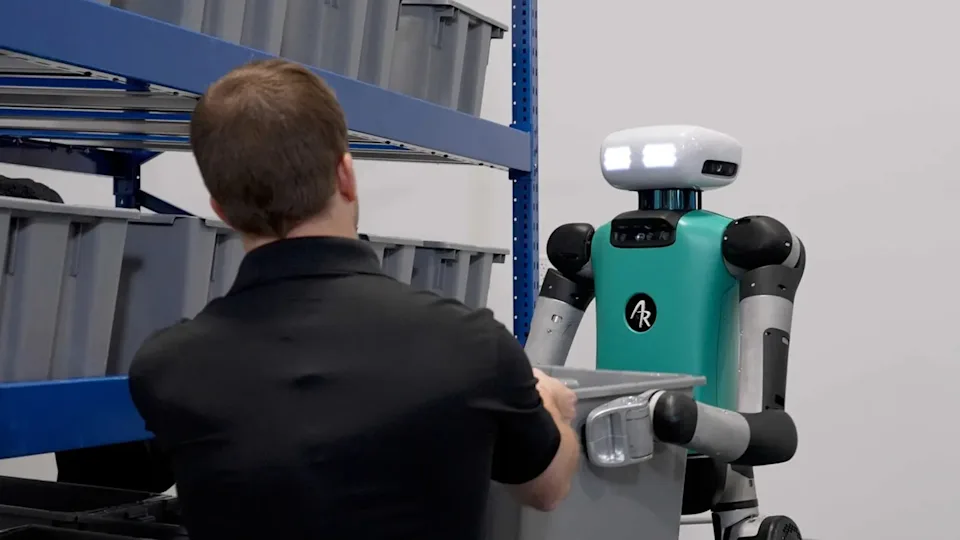
Agility's main product is a bipedal humanoid robot called Digit. Digit is not designed to look like a human. It has a head with sensors, a torso, two arms, and two legs that end in feet rather than wheels. Its job is to do repetitive and physically demanding work in warehouses, distribution centers, and manufacturing plants. This includes moving totes, picking up boxes, and loading items onto conveyor belts.
What makes Digit different from many other robots is that it is already working in real commercial environments. Agility has signed deals with major companies. GXO Logistics, a global contract logistics provider, is using Digit in its warehouses. Toyota Motor Manufacturing Canada has a commercial agreement. Schaeffler, a German automotive parts manufacturer, is also a customer. And AGCO, an agricultural equipment maker, plans to pilot Digit at its facility in Hesston, Kansas, beginning in 2027.
The company has accumulated more than 65,000 hours of real world operation. That is a significant number. It means the robots are not just prototypes sitting in a lab. They are out there, doing work, and proving that the technology is reliable enough for commercial use. This operational experience is a major competitive advantage. Many other humanoid robot companies are still in the testing phase. Agility has moved beyond that.
The Next Generation: Digit 5 and the $300 Million Order Book
In September 2026, Agility unveiled its next generation robot, Digit 5. This new model is designed for what the company calls cooperative safetyA design approach that allows robots to work safely in close proximity to humans without physical barriers like cages or fences.. It can work alongside people in dynamic industrial environments without needing to be separated by fences or safety cages. This is a huge step forward because it allows the robot to be integrated into existing workflows without expensive facility redesigns.
The market response to Digit 5 has been strong. Agility has already secured more than $300 million in committed multi year orders for Digit 5 from about 30 customers. These orders are subject to contractual milestones, but they represent a substantial backlog of demand. Deployments are expected to begin in early 2027, starting with Digit 4 and then transitioning to Digit 5.
To support this demand, Agility has built a manufacturing facility called RoboFab in Salem, Oregon. It is designed to produce up to 10,000 robots annually. The company also offers a cloud based software platform called Agility Arc, which allows customers to deploy and manage fleets of robots across multiple sites. This combination of hardware, software, and manufacturing capacity is what separates Agility from companies that are still in the research phase.
Humanoid Robots in a Changing Labor Market
The Agility Robotics IPO comes at a time when the nature of work is changing rapidly. Warehouses and factories are facing persistent labor shortages. Jobs in logistics and manufacturing are often physically demanding and repetitive, leading to high turnover rates. Humanoid robots like Digit are designed to fill these gaps, not by replacing entire workforces, but by taking on the tasks that are hardest to fill.
This is a sensitive topic. There is a widespread fear that robots will take jobs. But the current reality is more nuanced. Companies that deploy Digit are often struggling to hire enough workers to keep up with demand. The robot is being used to augment the existing workforce, not eliminate it. As we explored in our article on AI proof jobs and careers safe from automation, the roles that require physical adaptability and human judgment remain highly resilient. Digit is designed to complement those roles, not replace them.
The financial markets are also watching this sector closely. The recent AI sell-off in the stock market showed that investors are becoming more selective about AI investments. They want to see real revenue and real customers, not just promises. Agility's public listing will be a test of whether the market believes humanoid robots are ready for prime time. If AGLT performs well, it could open the door for other robotics companies to go public. If it struggles, it could make investors more cautious about the entire sector.
What This Means for the Robotics Industry
The listing of Agility Robotics is a landmark event. It gives the public a direct way to invest in the future of humanoid robotics. It also puts pressure on the company to deliver on its promises. Public companies must report their financials every quarter. They must answer to shareholders. They must show a path to profitability. This level of scrutiny is new for Agility, and it will test whether the business model can scale.
For the broader industry, the message is clear. Humanoid robotics is no longer a speculative dream. It is an emerging industry with real products, real customers, and real revenue. As the technology improves and costs come down, the potential market is enormous. Digit is just the beginning. The next decade will see these robots become a common sight in warehouses, factories, and perhaps even homes. The Agility Robotics IPO is the first chapter of that story being written on Wall Street.